Our company
Stage 2-3
AI use cases and small internal tools are starting to appear.
This change is not a vague future. It is a sequence already unfolding inside companies.
Employees start building work tools with AI, and data access plus operational control soon become the standard of competition. MAEK is a diagnostic frame for that transition point.
Competitive Question
In sales conversations, replace Company A and Company B with real customer interviews or named examples. This page creates one pressure: we need to answer where we are now.
Our company
Stage 2-3
AI use cases and small internal tools are starting to appear.
Competitor A
Stage 4-5
Business apps are increasing, but data connection and security review are becoming bottlenecks.
Leader B
Stage 6-8
Moving beyond document cleanup toward app-ready data structures and query engines.
Eight Predictable Moves
Experience and prediction are compressed into one diagnostic map. Each stage leads from signal, to question, to the next bottleneck.
CEOs, executives, and team leads start asking where AI should be used.
Do you have a plan that goes beyond tool subscriptions and changes the work itself?
Non-developers start building automations, internal web pages, and small apps themselves.
Are you ready to bring employee-built outputs into official workflows?
Team leads and managers see small wins and encourage more AI use.
Do you have operating standards when personal tools become organizational tools?
Apps can be built, but they need ERP, project, HR, and contract data.
Is there a standard path for safe access to business data?
Business teams want fast connections, while IT worries about security and maintenance responsibility.
Do you have a structure beyond CSV handoffs and one-off copies?
Markdown files, meeting notes, manuals, and policy documents accumulate in AI-readable form.
Are those documents connected to business concepts and data structures?
Documents exist, but apps lack stable entities, APIs, and permissions for reliable queries.
Are you managing the difference between AI-ready documents and app-ready data?
Companies require a knowledge brain, data query engine, vibe coding environment, and governance together.
Can employee-built apps safely use company knowledge?
Boardroom Diagnostic
The next competitive question is not "Are we using AI?" It is "Can AI-built work tools connect safely to company data?"
01
Small employee-built apps or automations already exist.
02
Business teams are asking to connect ERP, project, customer, or contract data.
03
IT hesitates to officially support them because of security, permissions, and maintenance responsibility.
04
Markdown files and meeting notes are accumulating, but they are hard to use directly in business apps.
05
When competitor examples come up, your company cannot clearly answer its current stage.
MAEK Position
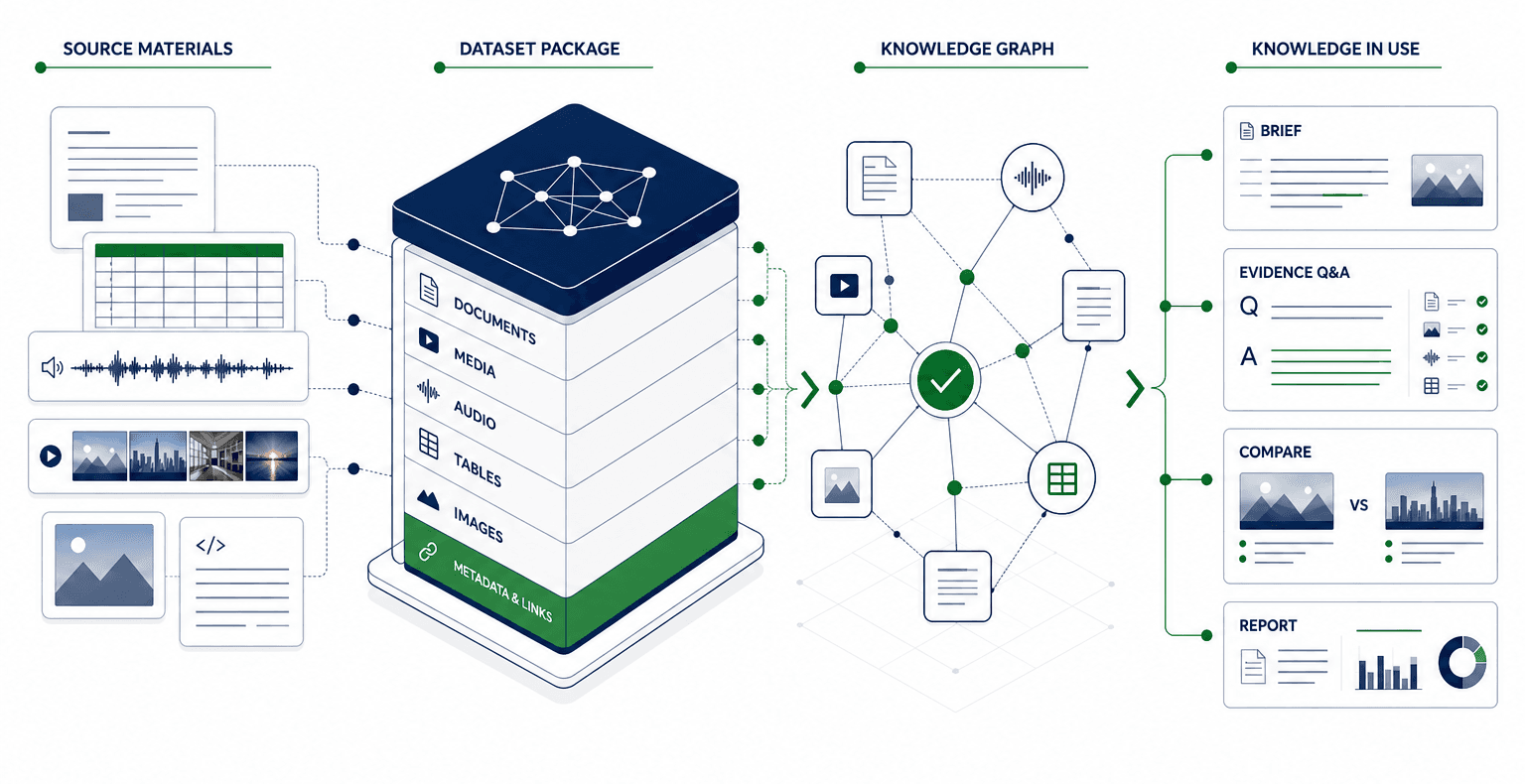
MAEK organizes scattered documents and data into AI-ready knowledge, then connects them to app-ready data interfaces that employee-built apps can use. IT keeps control over security, permissions, audit, and operations.
Brain
Data Query Engine
Vibe Coding Governance